
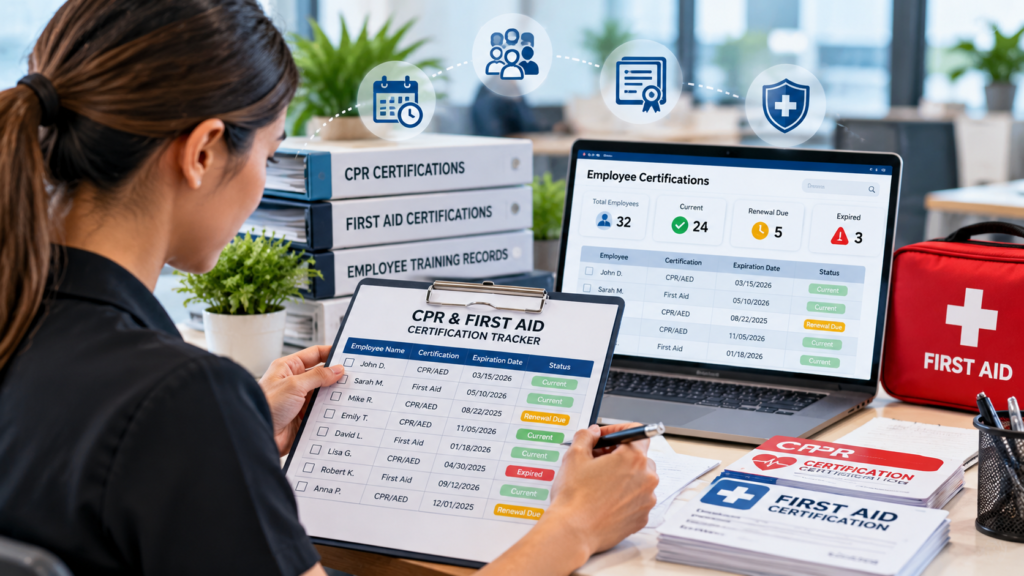
How to Keep CPR & First Aid Certifications Organized Across Multiple Employees
Managing CPR and First Aid certifications can become challenging when an organization has multiple employees, departments, locations, or work shifts. Without an organized tracking system, important renewal dates can be overlooked, training records can become outdated, and managers may struggle to identify which employees need training.
For employers, HR managers, and training coordinators, maintaining accurate certification records is an important part of workplace safety and employee development.
A structured CPR and First Aid certification tracking system helps organizations monitor completed training, upcoming expiration dates, and employees who need initial certification or renewal.
Instead of relying on memory or searching through old emails, employers can use a consistent process to keep training information accessible and up to date.
Why Certification Tracking Matters for Employers
CPR and First Aid certifications do not remain valid indefinitely. The validity period and renewal requirements depend on the specific course and certifying organization.
When an organization has many employees, keeping track of individual certification dates can become difficult without a centralized system.
Effective certification tracking can help employers:
Identify employees whose certifications are approaching expiration
Schedule renewal training in advance
Maintain organized employee training records
Identify employees who still need initial training
Coordinate training across departments and shifts
Reduce last-minute scheduling challenges
Support applicable workplace training requirements
An organized system also gives managers a clearer picture of their workforce’s training status.
Step 1: Create a Centralized Certification Tracking System
The first step is to store employee training information in one accessible location.
Depending on the size of your organization, this could be a spreadsheet, an HR management system, or a dedicated training management platform.
For smaller businesses, a well-maintained spreadsheet may be enough to get started.
Your tracking system should make it easy to identify each employee’s training status without having to search through multiple files or email conversations.
What Information Should You Track?
Consider including the following fields in your certification tracker:
Employee name
Department or job role
Work location
Shift or team
Training course completed
Certifying organization
Certification completion date
Expiration date, when applicable
Scheduled renewal date
Training status
Notes or documentation links
Only collect information needed for legitimate training management purposes, and restrict access to authorized personnel.
Step 2: Record Certification and Expiration Dates Accurately
Once you have created your tracker, enter the available information for each employee.
Check the actual certification documentation rather than estimating dates or relying on memory.
Different courses and certifying organizations may have different validity periods, so employers should verify the requirements for each specific certification.
For every employee, confirm:
Which course they completed
Whether the certification is current
The documented completion date
The applicable expiration or renewal date
Whether additional training is required for their position
Accurate records are the foundation of a reliable tracking system.
Step 3: Set Up Renewal Reminders
One of the easiest ways to improve certification management is to establish reminders before certifications expire.
Waiting until the expiration date approaches can make it harder to find available training dates and coordinate employee schedules.
Consider setting reminders at intervals such as 90, 60, and 30 days before the documented expiration date. These are suggested planning intervals, not universal certification requirements.
For example, your process might look like this:
90 Days Before Expiration
Review upcoming renewals and estimate how many employees need training.
60 Days Before Expiration
Contact your training provider and begin coordinating dates, employee availability, and group size.
30 Days Before Expiration
Confirm scheduled training and follow up with employees who have not yet been assigned a session.
The exact timeline can vary depending on your organization’s size, staffing needs, and training provider availability.
The goal is to give your team enough time to plan ahead.
Step 4: Use Clear Training Status Labels
A simple status system can make your tracker easier to understand at a glance.
Consider using these labels:
Current: Certification has been verified as valid.
Renewal Upcoming: The expiration date is approaching.
Training Scheduled: A training session has been arranged.
Training Needed: Initial or renewal training still needs to be arranged.
Verification Needed: Certification details require confirmation.
Expired: The documented certification has passed its expiration date.
These labels help HR teams and supervisors prioritize follow-ups.
Remember that an expired certification should not automatically be treated as proof that an employee is unqualified for every task. Employers should assess applicable role requirements and organizational policies before assigning duties that require current certification.
Step 5: Track Certifications Across Departments and Shifts
Organizations with multiple departments or work shifts need to look beyond individual expiration dates.
For example, a healthcare organization, assisted living facility, warehouse, or construction company may have employees working during the day, at night, and on weekends.
Training only one group may leave other teams without the appropriate training coverage.
When reviewing your certification tracker, consider:
Which departments have employees who need training
Whether relevant training needs are covered across shifts
Which work locations require additional training coordination
Whether new hires need initial certification
Whether employees have changed roles
Whether training coverage aligns with the organization’s emergency response plan
This approach helps employers manage training as part of a broader workplace safety strategy.
Step 6: Include CPR and First Aid Training in Employee Onboarding
Certification tracking should begin when employees join the organization, not only when existing certifications are about to expire.
During onboarding, identify whether each new employee needs CPR, AED, First Aid, or another form of emergency response training based on their role and applicable requirements.
Your onboarding process can include:
Reviewing the employee’s training requirements.
Verifying any existing certification documentation.
Identifying training gaps.
Scheduling the appropriate course.
Recording completion details.
Adding applicable expiration or renewal dates to the tracker.
This process helps new employees enter the organization’s training system from the beginning.
Step 7: Choose a Training Provider That Supports Your Schedule
Once you identify employees who need training, the next step is arranging appropriate courses.
For organizations with multiple employees, coordinating individual appointments may take significant time.
Group or on-site training may offer a more convenient option, depending on your organization’s needs and the provider’s availability.
When selecting a training provider, consider:
Available CPR and First Aid courses
Instructor qualifications
Hands-on skills practice
Certification requirements
Group training options
On-site training availability
Scheduling flexibility
Documentation provided after successful completion
Confirm that the selected course and certification meet the requirements applicable to your employees before booking.
You can also read our article, How to Build an Effective Workplace CPR & First Aid Training Plan, for additional guidance on organizing employee training.
Step 8: Keep Training Documentation Organized
A certification tracker is most useful when its information matches the supporting documentation.
Store completion records and certification documents in a secure, organized location that authorized managers can access when necessary.
Consider organizing records by:
Employee
Department
Training course
Work location
Completion date
Expiration or renewal date
Establish a process for updating records after employees complete training.
For example, designate an HR representative or training coordinator to verify completion details and update the tracker within a defined period after receiving the documentation.
Avoid leaving records unchanged after employees complete a renewal course or change roles.
Step 9: Review Your Tracker Regularly
Certification tracking should be an ongoing responsibility rather than a task performed once a year.
A monthly review can help organizations identify upcoming expirations, outstanding training, and missing documentation.
During each review, check for:
Certifications approaching expiration
Employees who still need training
Recently completed courses that have not been recorded
Missing or inconsistent dates
Employees who have left the organization
New employees who need to be added
Changes in roles or training requirements
Regular reviews help keep records accurate and make it easier to plan upcoming training.
Common Certification Tracking Mistakes to Avoid
Even organizations with a tracking system can experience problems if the process is not maintained.
Relying on Employees to Remember Expiration Dates
Employees may not always remember when their certifications expire. Use a centralized tracker and scheduled reminders instead of relying entirely on individual follow-ups.
Keeping Records in Multiple Unconnected Files
Scattered spreadsheets and email attachments can make it difficult to determine which information is current. Establish one primary tracking system.
Recording Dates Without Verifying Documentation
Incorrect expiration dates can lead to missed renewals or unnecessary scheduling. Verify information against the applicable certification records.
Forgetting New Hires and Role Changes
Review training requirements whenever an employee joins the organization or moves into a different position.
Waiting Until the Last Minute to Schedule Training
Last-minute planning can create unnecessary pressure, especially when several employees need training at the same time. Start coordinating renewals in advance.
Focusing on Certificates Without Reviewing Preparedness
Certification records are important, but they are only one part of emergency preparedness. Organizations should also review applicable emergency procedures, equipment access, and opportunities for employees to practice their skills.
How Organized Certification Tracking Supports Workplace Safety
An effective certification tracking system gives employers a clearer understanding of employee training needs.
Instead of asking, “Whose certification is expiring soon?” managers can review a centralized record to identify upcoming renewals, training gaps, and outstanding documentation.
This can make training coordination more predictable and help organizations maintain a consistent process across employees, departments, and work locations.
When certification tracking is combined with appropriate CPR and First Aid training, organizations can take a more organized approach to employee development and emergency preparedness.
Final Thoughts
Managing CPR and First Aid certifications across multiple employees does not have to be complicated.
A centralized tracker, accurate records, scheduled reminders, clear training statuses, and regular reviews can help employers stay organized and plan training more effectively.
The most important step is establishing a consistent process that fits your organization’s size, staffing structure, and applicable training requirements.
When employers plan ahead, certification management becomes easier to maintain and workplace training becomes easier to coordinate.
Need Help Coordinating CPR and First Aid Training for Your Team?

Keeping track of employee certifications is only one part of maintaining workplace preparedness. Organizations also need a practical way to arrange initial and renewal training when employees require it.
Amara Career Training provides CPR and First Aid training for organizations looking to equip their employees with practical emergency response skills.
Whether you need to train a group of new employees, coordinate renewal sessions, or organize training for a larger team, we can help you explore suitable training options for your organization’s needs.
Plan ahead. Keep your team organized. Strengthen your workplace preparedness.
Contact Amara Career Training to learn more about CPR and First Aid training for your organization.