
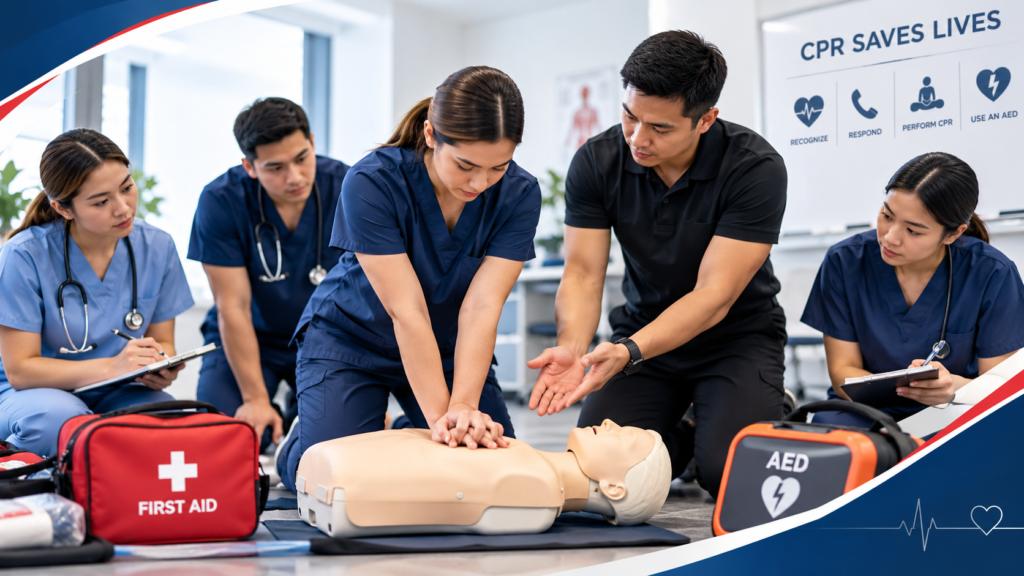
Choosing a CPR training provider is an important decision for healthcare organizations.
Healthcare managers need to consider more than simply finding a course with an available date. The training provider should be able to deliver appropriate instruction, practical skills practice, and a training experience that fits the organization’s needs.
A good CPR training program should help employees understand what to do during an emergency and give them opportunities to practice essential skills.
For healthcare managers, the right provider should also make training easier to coordinate across employees, departments, and schedules.
Before booking a CPR training provider, consider these key factors.
1. Look for Qualified and Experienced Instructors
The instructor plays an important role in the training experience.
Healthcare employees are learning practical emergency response skills, so the instructor should be able to explain concepts clearly, demonstrate skills, answer questions, and provide appropriate feedback during practice.
When evaluating a provider, healthcare managers can ask:
- Who will be conducting the training?
- What instructor qualifications or credentials do they hold?
- Does the instructor have experience working with healthcare professionals?
- Will participants have opportunities to ask questions?
- Will the instructor provide feedback during hands-on practice?
An experienced instructor can help make a training session more engaging and practical.
2. Make Sure the Training Includes Hands-On Practice
CPR is a physical skill.
Reading instructions or watching a demonstration can help employees understand the concepts, but participants also need opportunities to practice the skills they are learning.
A quality CPR training session should provide appropriate hands-on practice with training equipment.
Participants may have opportunities to practice:
- CPR techniques
- Chest compressions
- AED-related procedures
- Emergency response steps
- Team communication during simulated scenarios
Hands-on practice gives employees an opportunity to become more familiar with the physical steps involved in CPR.
For more information, read Why Hands-On Training Is More Effective Than Online-Only CPR Courses.
3. Check What Certification the Course Provides
Certification is another important consideration when selecting a CPR training provider.
Healthcare managers should understand exactly what certification participants receive after successfully completing the course.
Before booking, ask the provider:
- What certification is issued?
- Who recognizes or accepts the certification?
- How long is the certification valid?
- What are the requirements for completing the course?
- Is there a hands-on skills component?
- How are completion records provided?
Certification requirements can vary depending on the course, profession, employer, and applicable organization or workplace requirements.
Healthcare organizations should verify that the specific course and certification meet their employees’ applicable requirements before scheduling training.
4. Consider Whether the Training Fits Your Healthcare Team
Healthcare organizations aren’t all structured the same way.
A small medical office may have different training needs from a large healthcare facility with multiple departments and shifts.
When evaluating a provider, consider:
- Number of employees who need training
- Employee roles
- Department requirements
- Shift schedules
- Location
- Training frequency
- Certification expiration dates
A provider should be able to help the organization determine a practical training arrangement based on its needs.
5. Ask About On-Site Training Options
For healthcare organizations with multiple employees, on-site training can be a convenient option.
Instead of requiring employees to travel individually to a training location, an instructor can conduct the session at the organization’s facility.
Potential benefits include:
- Reduced employee travel
- Easier group scheduling
- Convenient location
- Hands-on training for multiple employees
- Less logistical coordination for staff
On-site training may be particularly useful for healthcare organizations that need to coordinate training around patient care and staffing schedules.
You can learn more about How On-Site CPR Training Minimizes Workplace Disruptions During Emergencies.
6. Look for a Provider That Can Work With Your Schedule
Healthcare organizations often operate around demanding schedules.
Employees may work:
- Day shifts
- Evening shifts
- Overnight shifts
- Weekends
- Rotating schedules
A training provider that offers flexible scheduling options can make it easier for managers to coordinate employee participation.
When contacting a provider, ask about:
- Available training dates
- Group training
- On-site scheduling
- Training duration
- Number of participants per session
- Options for multiple sessions
The goal is to find a training arrangement that supports both employee development and the organization’s operational needs.
7. Evaluate the Training Equipment and Learning Environment
CPR training should give participants the opportunity to practice using appropriate training equipment.
Depending on the course, this may include CPR manikins, AED training devices, and other First Aid training materials.
A professional learning environment can also help participants stay focused and engaged throughout the session.
Healthcare managers can ask providers what equipment is included and how much time participants will spend practicing their skills.
8. Ask How the Provider Handles Group Training
If you’re training multiple employees, group training can make the process more efficient.
However, managers should still consider whether participants will receive enough individual practice and instructor attention.
Ask:
- How many participants are included in a session?
- Will each participant have an opportunity to practice?
- How does the instructor provide individual feedback?
- Can the provider accommodate multiple groups?
The goal isn’t simply to train as many employees as possible in one session.
The goal is to provide employees with meaningful opportunities to learn and practice the required skills.
9. Consider Certification Tracking and Documentation
Managing CPR certifications can become challenging when an organization has many employees.
Managers may need to keep track of:
- Employee names
- Course completion dates
- Certification expiration dates
- Training records
- Renewal schedules
Before choosing a provider, ask what documentation participants receive after completing training and what records the organization can retain.
Keeping accurate records can make future renewals easier to manage.
For additional guidance, see How to Build an Effective Workplace CPR & First Aid Training Plan.
10. Look Beyond Price When Comparing Providers
Cost is naturally an important consideration for healthcare organizations.
However, choosing a provider based solely on the lowest price may not provide the best overall value for the organization.
Managers should consider the complete training experience, including:
- Instructor qualifications
- Hands-on practice
- Course content
- Certification
- Training equipment
- Scheduling flexibility
- On-site options
- Group size
- Documentation
- Customer support
The goal is to find a provider that offers training appropriate for the organization’s needs and employee responsibilities.
Questions Healthcare Managers Should Ask Before Booking
Before selecting a CPR training provider, consider asking these questions:
About the Instructor
- Who will conduct the training?
- What qualifications does the instructor have?
- Does the instructor have experience training healthcare teams?
About the Course
- What does the course cover?
- Is hands-on practice included?
- What certification will participants receive?
- What are the completion requirements?
About Scheduling
- Do you offer on-site training?
- How many employees can participate?
- Can training accommodate multiple shifts?
- How far in advance should we schedule?
About Documentation
- How are certifications documented?
- What records will the organization receive?
- How can managers keep track of completed training?
Asking these questions before booking can help healthcare managers compare providers more effectively.
Why Hands-On CPR Training Matters for Healthcare Teams
Healthcare employees may already have extensive knowledge and experience, but emergency response skills still require practical application.
Hands-on CPR training gives participants an opportunity to practice skills rather than simply read or watch demonstrations.
Practice can help employees become more familiar with the sequence of emergency response actions and the physical techniques involved.
Regular training can also help organizations keep emergency preparedness visible among their teams.
Read Why CPR Skills Fade Over Time Without Regular Practice to learn more about skill retention and ongoing practice.
Choosing a CPR Training Provider Is About More Than a Certificate
A CPR certificate is an important outcome of training, but it shouldn’t be the only factor healthcare managers consider.
The training experience itself matters.
Healthcare organizations should look for a provider that can deliver:
- Qualified instruction
- Hands-on practice
- Appropriate certification
- Practical learning
- Flexible scheduling
- Reliable documentation
- Training that fits the organization’s needs
When these elements come together, CPR training becomes more than a certification exercise.
It becomes part of a broader approach to emergency preparedness and employee development.
Final Thoughts
Choosing a CPR training provider is an important decision for healthcare managers.
The right provider should offer more than a convenient training date. Managers should consider instructor qualifications, hands-on practice, certification, equipment, scheduling, group size, documentation, and the overall learning experience.
Taking time to evaluate these factors can help healthcare organizations choose training that fits their employees and operational needs.
Prepared healthcare teams start with quality training and practical opportunities to develop emergency response skills.
Ready to Train Your Healthcare Team?

Finding the right CPR training provider doesn’t have to be complicated.
Amara Career Training provides hands-on CPR and First Aid training designed to help healthcare organizations equip their teams with practical emergency response skills.
We offer training options that can be coordinated around your organization’s needs, including on-site training for healthcare teams.
Whether you’re training a small group or coordinating training for a larger team, Amara Career Training can help you create a practical and convenient training experience.
Give your healthcare team the training, practice, and confidence they need to be better prepared for emergencies.
Contact Amara Career Training to learn more about CPR and First Aid training for your organization.